Choose a crystal tower when you want a clean vertical silhouette and an easy-to-read focal point. Choose a cluster shape when you prefer several peaks, more texture, and an outline that changes from every angle. The best choice depends less on symbolic meaning and more on the piece's footprint, height, construction, and the space where you plan to display it.
The word "cluster" can describe either a natural mineral formation or a carving inspired by clustered points. A product title alone may not tell you which one it is. This guide compares three current HighlandCrystal examples so you can check the structure before choosing a material or color.
Tower and cluster shapes at a glance
| Display shape | Visual effect | What to verify |
|---|---|---|
| Single-point tower | Tall, geometric, and directional | Height, base stability, weight, and selected option |
| Carved point cluster | Several smooth peaks in a compact form | Carved construction, width, height, and material option |
| Natural crystal cluster sculpture | Irregular mineral texture and varied outline | Exact-piece photos, dimensions, formation, and support |
Choose a tower for a vertical focal point
A tower is useful when you want one strong line rising from a shelf, desk, or display tray. Its pointed top makes the overall shape easy to recognize even when it sits beside books, candles, or smaller carvings. A narrow form may also work where horizontal space is limited, but the base still needs enough room to sit securely.
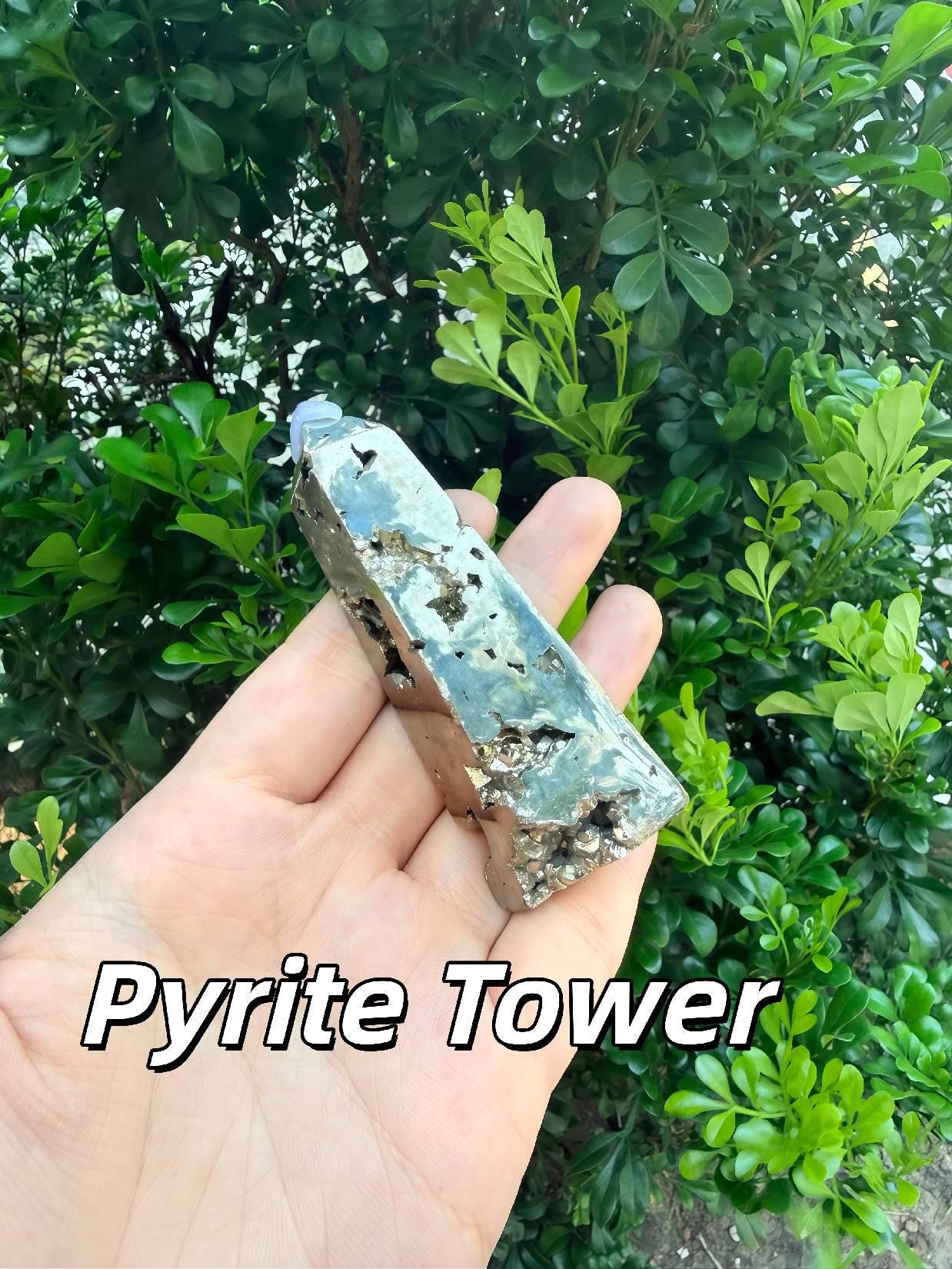
HighlandCrystal's hand-carved pyrite tower is listed in multiple specification options, including options described as about 3.4 or 3.6 inches with weight ranges. Read the selected option rather than treating every image as the same size. The listing also notes that natural color, markings, texture, and formation can vary.
Pyrite is an iron sulfide mineral with a metallic luster, and mineral references describe it as brittle. That makes careful placement more useful than testing its durability. Keep a tower away from a shelf edge, and follow the listing's care direction to avoid drops, prolonged water exposure, harsh chemicals, and high heat.
Choose a carved point cluster for a compact mountain-like outline
A carved point cluster provides several peaks without requiring the open, irregular structure of a natural cluster. It can be a practical choice for a small desk or bedside display when you want more visual movement than a single tower.
The mixed-gemstone point cluster carving is described as machine carved into a smooth, mountain-like shape. Its current listing gives an approximate size of 2.3 inches high by 1.3 inches wide and a weight of 80 to 90 grams. Those details make it easier to plan a compact display, but they do not turn it into a naturally formed crystal cluster.
If the listing offers several gemstone appearances in photos, confirm which material or piece the active option represents. "Mixed gemstone options" describes the range of possible materials, not necessarily everything included in one purchase.
Choose a natural cluster when texture is the main feature
A natural cluster can have an irregular footprint, varied points, and more visible depth than a simplified carving. It often works best when it has some open space around it so its outline can be seen from more than one direction.
HighlandCrystal's amethyst and clear quartz cluster decor is presented as a decorative sculpture using two natural crystals. The listing tells shoppers to refer to its photos and measurements for actual size and notes that color, transparency, inclusions, texture, and formation may vary.
Because variation is part of this style, ask whether the photographed item is the exact piece being sold or a representative example. Also check the resting surface. An irregular specimen may need more width than its tallest point suggests, and a display stand shown in a styled photo should not be assumed to be included unless the listing says so.
Measure the display space before choosing the stone
Start with the available height, width, and depth. For a narrow shelf, measure the usable surface rather than the distance between objects at eye level. For a desk, leave enough clearance for your hands, cables, and frequently moved items.
Then decide whether you want one vertical point, a compact group of carved points, or an irregular natural formation. Material and color can come next. This order reduces the chance of choosing a piece you like in a photo but cannot display safely.
Questions to check before ordering
- Is the shape carved, naturally formed, or assembled from more than one material?
- What are the actual height, width, depth, and weight of the selected option?
- Does the photo show the exact piece or a representative example?
- Is a stand, base, tray, or other support included?
- Which material corresponds to the option currently selected?
- What cleaning and storage instructions does the seller provide?
Common buying questions
Is every multi-point crystal a natural cluster?
No. Some multi-point pieces are carved from stone into a cluster-inspired shape. Read the construction details and look for language such as machine carved, hand carved, or natural formation.
Which shape is best for a small desk?
A compact tower or mini carved cluster may be easier to place, but measurements decide the fit. Compare the base or widest point, not only the listed height.
Do crystal towers and clusters require different care?
Care depends on the material and construction. For the products discussed here, the listings recommend careful handling, avoiding impacts and prolonged water exposure, and cleaning gently with a soft, dry cloth. Follow the instructions for the specific piece you purchase.