
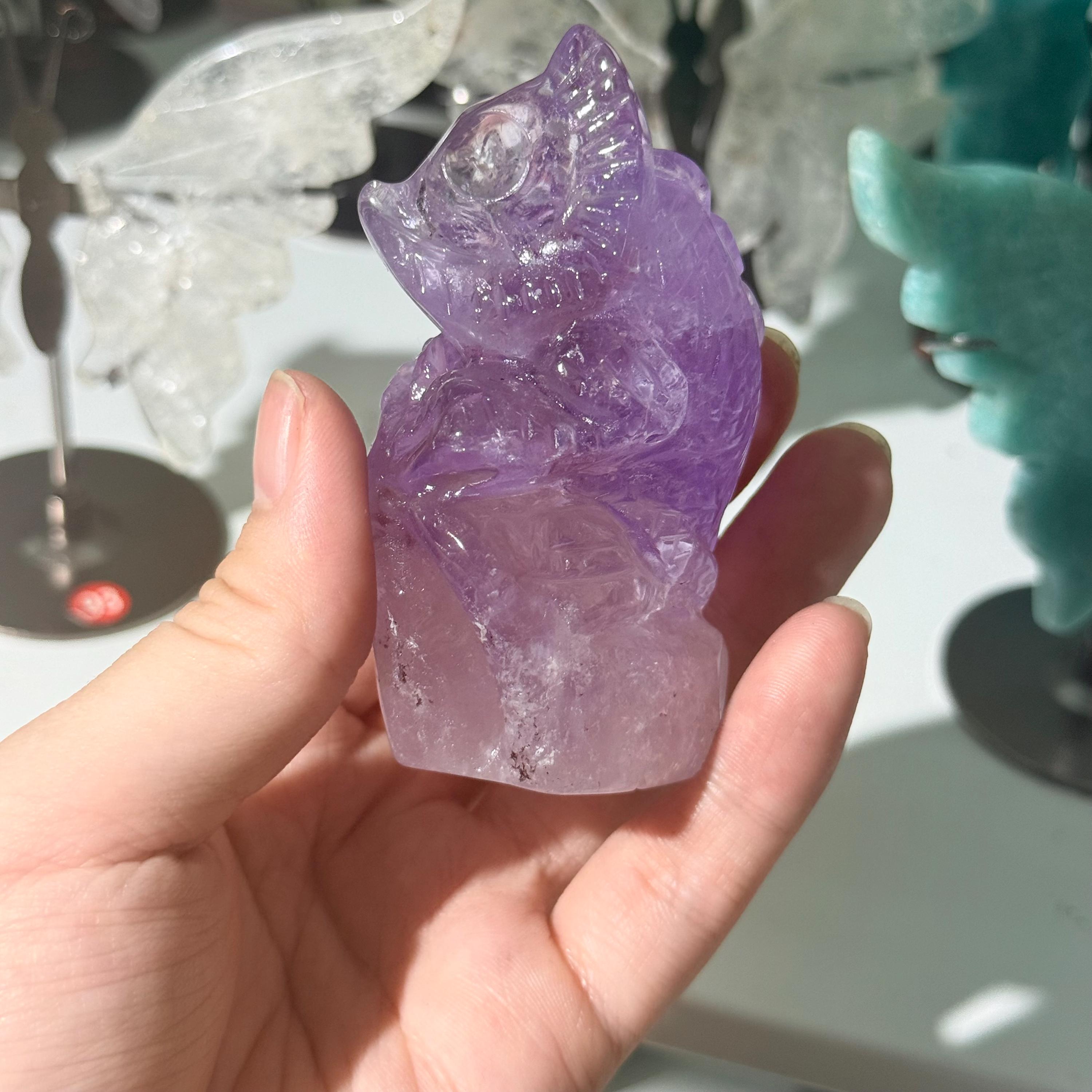
Choose a crystal carving by its finished design first, then use the stated carving method to refine your decision. For a mountain-inspired miniature, consider HighlandCrystal’s mixed gemstone point cluster. For an animal design with explicitly described machine-assisted shaping and hand finishing, consider the amethyst lizard. If a listing that specifically describes hand carving matters to you, consider the Montebrasite bear. These three pieces make a useful comparison because their descriptions explain different approaches to shaping decorative stone.
A process label answers only part of a buying question. You also need to know what the object depicts, how its surface is described, and whether its natural variations suit your expectations. Here is how to read those details without turning a production term into an unsupported promise of quality.
What the carving descriptions actually say
| Product | Stated shaping method | Design and surface details | Choose it when |
|---|---|---|---|
| Mixed gemstone point cluster | Machine carved | Mountain-like form with smooth, pointed details | You prefer a miniature landscape-inspired display |
| Amethyst lizard | Machine-assisted carving, finished and polished by hand | Lizard form with lavender and purple tones | You want a reptile subject and a clearly described finishing process |
| Montebrasite bear | Hand carved | Bear form with a smooth, polished finish | You prefer a bear subject and explicitly stated hand carving |
Three pieces to compare
Mixed gemstone point cluster: prioritize the overall form
The mixed gemstone point cluster carving is described as machine carved from natural stone. Its simple mountain-like shape and smooth, pointed details take inspiration from crystal formations and mountain peaks. The description identifies desks, shelves, bedside tables, and small display areas as intended settings.
Choose this piece if the appeal is a sculpted landscape rather than a recognizable animal. Its miniature format makes it a relevant starting point for someone planning a small decorative arrangement. Treat “cluster” as part of the design description: the listing identifies this object as a carving inspired by natural formations.
The description mentions multiple gemstone materials, while the supplied option field shows only “Default.” That does not establish a selectable material menu. Base your interest on the listed shape and natural variation, and resolve any material preference before making a purchase decision.
Amethyst lizard: distinguish shaping from finishing
The amethyst lizard carving offers the clearest explanation of a combined process. Its description says the overall shape is created with machine-assisted carving, then finished and polished by hand. This is useful information when you want to understand which stages the wording covers.
The stone is described as having soft lavender and purple tones, natural translucency, mineral markings, and internal inclusions. Choose it because you enjoy the reptile subject and those described visual characteristics. The hand finishing is an additional process detail; it does not establish how much time was spent on each piece or make this carving automatically preferable to another.
This listing also explains that natural patterns differ between pieces and that lighting and screen settings can affect apparent color. A sensible expectation is an amethyst lizard with individual stone characteristics, rather than an identical repeat of every pictured marking.
Montebrasite bear: look beyond the hand-carved label
The Montebrasite bear carving is described as hand carved, with a smooth, polished finish. Its stated blue-green hue and brown or bronze inclusions give you concrete visual details to consider alongside the production wording. The description presents it as a desk decoration or an addition to a mineral or crystal collection.
Choose this piece if the bear form itself belongs in your display. The listing notes that slight texture variations are expected because of natural inclusions. Read “smooth, polished” together with that qualification: the finish description does not promise an entirely uniform surface.
A practical checklist before choosing
- Pick the subject. Decide whether you want mountain-inspired points, a lizard, or a bear. Imagine which design you would still enjoy if its individual markings differed.
- Separate the process stages. Shaping, finishing, and polishing may appear as separate statements. Preserve those distinctions when comparing listings.
- Read the variation notes. Each of these descriptions allows for individual stone characteristics. Avoid making one particular marking the reason for your choice.
- Check whether the options answer your question. A general description of material variety does not necessarily identify what a particular option represents.
- Consider routine care. All three descriptions recommend gentle cleaning with a soft, dry cloth. Follow the selected product’s additional care instructions.
For your final decision, return to the object you want to display. The cluster emphasizes a mountain-like composition, the lizard offers a reptile design with an explicitly described combined process, and the bear pairs an animal subject with stated hand carving. Let the production wording inform your choice while keeping the finished design at the center of it.