
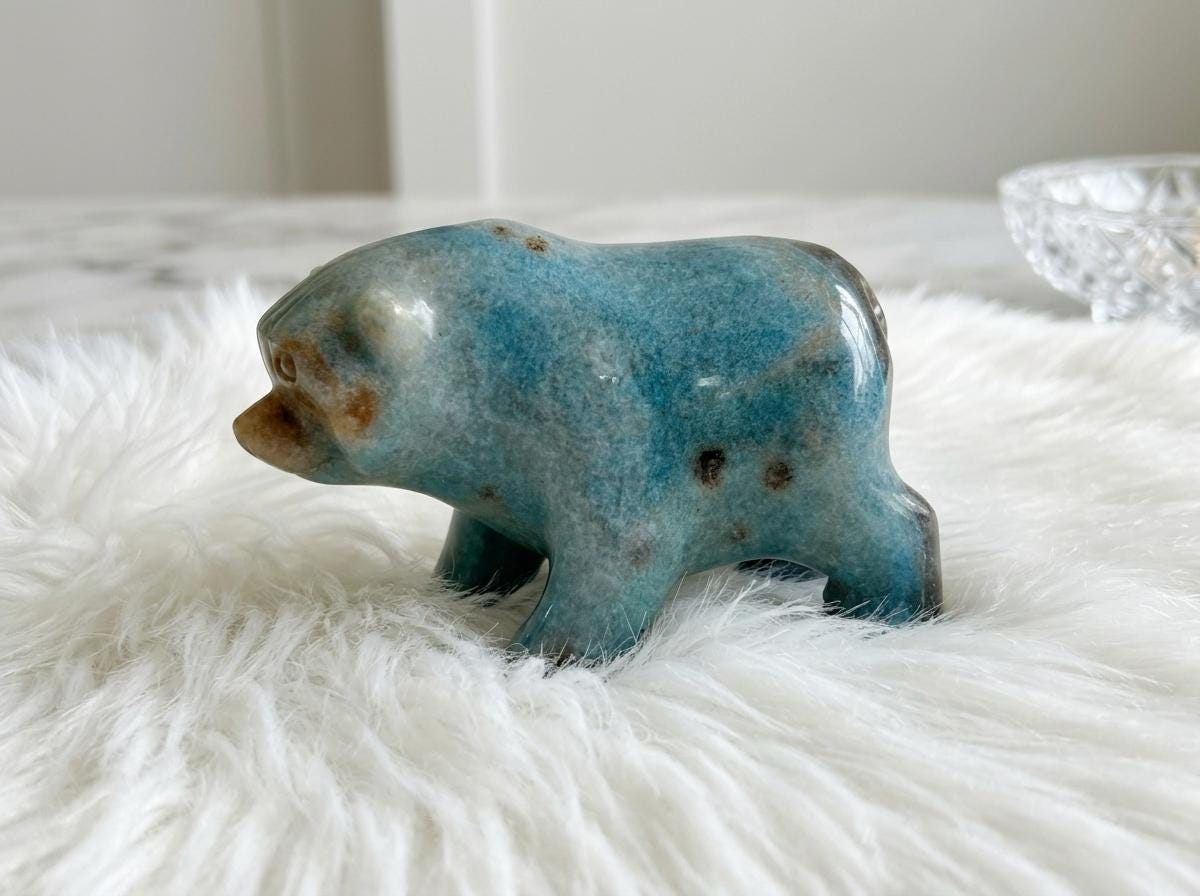
Choose a stone sculpture by repeating one feature of your wall art: its subject, a noticeable color, or its overall shape. For an earthy landscape, start with the Montebrasite Bear Carving. For artwork with feather details or purple accents, consider the Purple Fluorite Peacock. For playful illustrations or rounded abstract forms, look at the Mixed Gemstone Balloon Dog. These three HighlandCrystal designs offer different ways to connect a tabletop display with the artwork above it.
You do not need a perfect match. A sculpture can make a pairing feel deliberate through one clear connection while adding a different material and a three-dimensional form. Before choosing, decide whether you want the artwork or the carving to attract attention first.
Start With the Artwork You Already Enjoy
Look at your print or painting from the place where you usually see it. Identify the feature that remains noticeable at that distance. It might be a blue-green area, an animal subject, a repeated curve, or a detailed ornamental shape. Use that feature as your buying criterion instead of trying to match every color in the image.
Next, consider the surface beneath or beside the artwork. Leave enough visual separation for the sculpture's outline to remain clear. If the art contains many small details, a simpler sculptural subject may be easier to appreciate. If the image has broad, open areas, a carving with more detail can introduce another point of interest.
| Your artwork | Carving to consider | Connection to explore |
|---|---|---|
| Landscapes or woodland subjects | Montebrasite bear | Animal form and blue-green, brown, and bronze coloring |
| Bird illustrations or decorative compositions | Purple fluorite peacock | Displayed tail feathers and purple banding |
| Playful graphics or rounded abstract shapes | Gemstone balloon dog | Rounded body, curved legs, and balloon-inspired form |
Three Different Pairing Directions
Montebrasite Bear: Connect With a Landscape
The Natural Montebrasite Bear Carving is described as a hand-carved bear with a blue-green hue, brown or bronze inclusions, and a smooth, polished finish. Those supplied colors provide a useful starting point for artwork featuring similar cool and earthy passages.
Choose this bear when you want a recognizable animal subject alongside a landscape or nature study. The connection can come from the scene itself, even if the artwork contains no bear. Alternatively, place it near an abstract print that repeats blue-green and brown. That approach connects the objects through color while keeping their subjects different.
The listing notes slight texture variations associated with natural inclusions. Buy for the overall combination of bear form and stone character, allowing room for those variations instead of planning around a particular small marking.
Purple Fluorite Peacock: Echo Decorative Detail
The Purple Fluorite Peacock Carving features a hand-carved peacock displaying its tail feathers. Its description identifies deep purple tones with natural white and pale green banding, along with translucent qualities visible when held to the light.
This is the strongest candidate here when the connection you want is ornamental detail. Consider it beside a bird illustration, a decorative print, or artwork with a purple accent you would like to repeat. You can also use the feathered subject to introduce detail beneath a simpler image.
Keep the display readable by giving the tail outline some open space around it. Avoid making translucency the sole reason for your choice: the listing's description concerns the stone when held to the light, which does not establish how it will appear in your particular display location.
Gemstone Balloon Dog: Repeat Playful Curves
The Mixed Gemstone Balloon Dog Carving has a rounded body, curved legs, and a balloon-inspired shape. The description calls its appearance fun and modern and states that its machine-assisted form is finished and polished by hand.
Choose this design when your artwork uses rounded shapes, humorous subjects, or a playful drawing style. Its outline provides the clearest basis for the pairing. A shared curve can connect the sculpture and image even when their colors differ.
The description mentions varied gemstone materials, with differences in color, translucency, markings, and pattern. The supplied option wording does not provide an individual material menu. Make the balloon-dog design your starting point, and check the product's option details before committing to a specific color plan.
Make the Final Choice
- Name one connection. Choose a shared subject, color, or shape that you can describe in a few words.
- Choose the focal point. Give a detailed carving room to stand out, or let it serve as a smaller visual companion to the artwork.
- Allow for natural variation. A broad palette or recognizable outline is a more flexible pairing target than one precise vein or inclusion.
- Check the intended placement. Review the product details against your available surface before purchasing.
For care, the bear listing recommends a soft, dry cloth and avoiding prolonged harsh direct sunlight. The peacock listing also specifies gentle dry cleaning, protection from sharp impacts and prolonged direct sunlight, and no immersion in water. Choose a display location that lets you enjoy both the art and the carving while following the selected product's care directions.